
Home
Join Our Newsletter
Enter your email and we'll keep you posted with news and updates!
[fluentform id="4"]
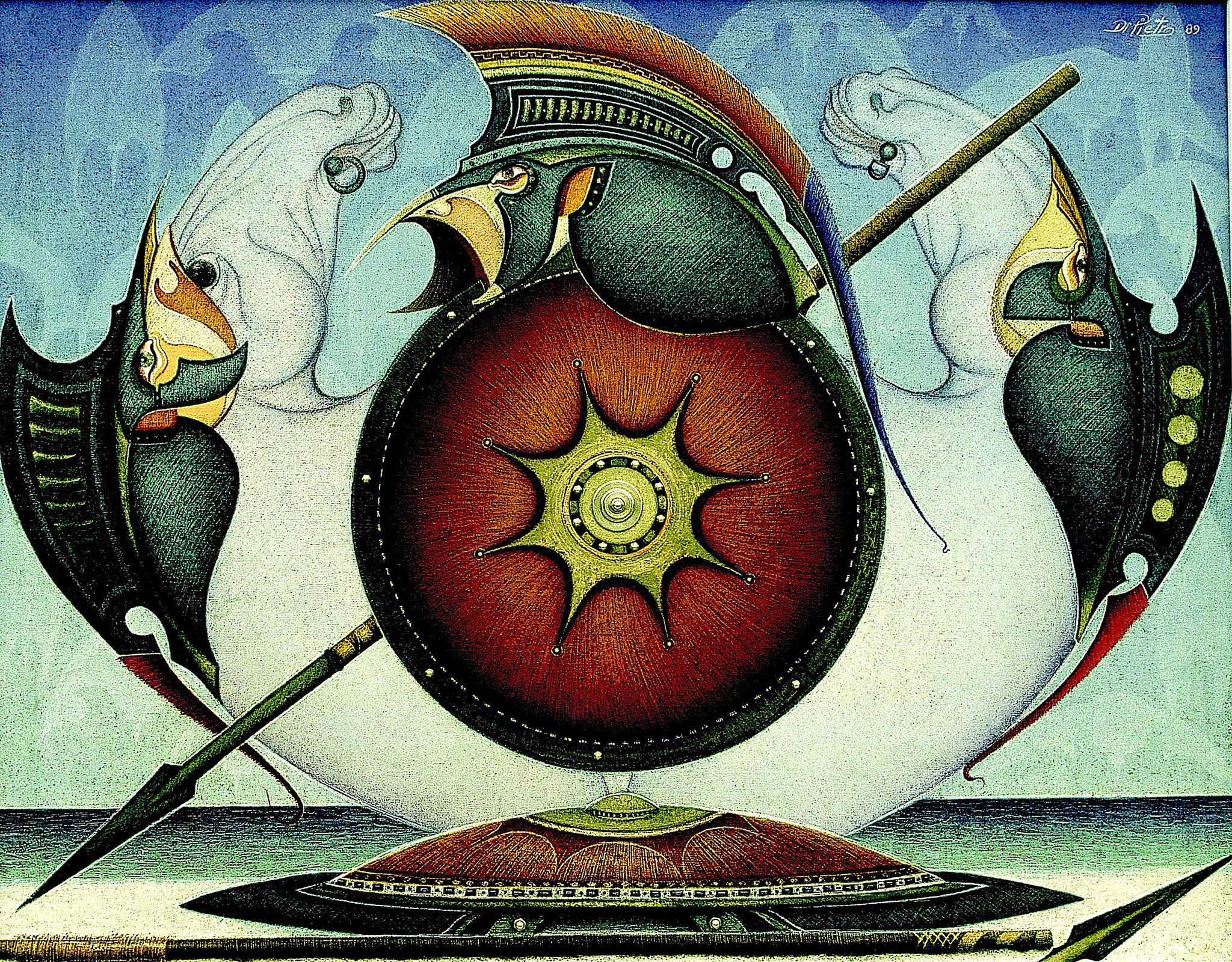
Olio inciso su tela cm. 80x100 - III periodo 1985 /1995.
Raccontare l’Iliade di Omero si configura come un’avventura artistica al tempo stesso programmata e meditata, ma anche spontanea nel suo nascere. Come accade per molte esperienze della vita, il percorso prende avvio quasi per gioco, mosso da curiosità e da un’esplorazione libera delle proprie possibilità espressive, senza pretese immediate, ma sostenuto dal desiderio di dare forma alle fantasie interiori.
In questo processo, il disegno si impone come primo strumento di indagine e di costruzione visiva; successivamente, la scena si amplia fino a diventare vera e propria scenografia, simile a quella di un film. L’artista assume così il ruolo di regista, orchestrando figure, spazi e dinamiche narrative, consapevole che un racconto epico come questo esige una rappresentazione capace di rendere la sua grandezza simbolica e mitica.
Il colore, nella sua dimensione universale, offre un linguaggio condiviso e immediato; tuttavia è il segno — il tratteggio, la linea, la costruzione della scena — che consente una rilettura personale. Proprio attraverso il segno, infatti, la narrazione può essere reinterpretata in chiave contemporanea, aprendo la via a una nuova figurazione, capace di coniugare tradizione e innovazione, memoria storica e sensibilità attuale.
dpb - “Warriors and Horses” from Memories of the Iliad: engraved oil on canvas, 80 × 100 cm – Third Period, 1985–1995 -
“The Iliad as a Visual Experience: Between Artistic Direction and New Figuration
Telling Homer’s Iliad takes shape as an artistic adventure that is both planned and carefully studied, yet also spontaneous in its origin. As with many experiences in life, the process begins almost playfully, driven by curiosity and a free exploration of one’s expressive possibilities, without immediate ambition, but supported by the desire to give form to inner imagination.
In this process, drawing emerges as the primary tool of investigation and visual construction; subsequently, the scene expands into a true scenography, similar to that of a film. The artist thus assumes the role of director, orchestrating figures, spaces, and narrative dynamics, aware that an epic story such as this demands a representation capable of conveying its symbolic and mythic grandeur.
Color, in its universal dimension, offers a shared and immediate language; however, it is the mark — the line work, the hatching, the structuring of the scene — that allows for a personal reinterpretation. Through this mark, in fact, the narrative can be reimagined in a contemporary key, opening the way to a new figuration capable of combining tradition and innovation, historical memory and present-day sensibility.-
