Home
Join Our Newsletter
Enter your email and we'll keep you posted with news and updates!
[fluentform id="4"]
di BRUNO DI PIETRO
La storia di Elena di Sparta e Paride è uno dei racconti più celebri della mitologia greca, all’origine della Guerra di Troia.
Elena, considerata la donna più bella del mondo, era moglie di Menelao, re di Sparta. Paride, principe di Troia, fu chiamato a scegliere quale tra tre dee: Era, Atena e Afrodite—fosse la più bella. Sedotto dalla promessa di Afrodite, che gli avrebbe donato l’amore della donna più bella del mondo, Paride la scelse come vincitrice.
Guidato da questo destino, Paride giunse a Sparta e conobbe Elena. Tra i due nacque un amore irresistibile (o, secondo alcune versioni, Elena fu rapita), e Paride la portò con sé a Troia. Questo gesto scatenò l’ira di Menelao, che, con l’aiuto del fratello Agamennone e di molti eroi greci, organizzò una spedizione per riportarla indietro.
Così ebbe inizio la lunga e sanguinosa Guerra di Troia, che vide contrapporsi Greci e Troiani per dieci anni, trasformando una storia d’amore in un mito di passione, destino e distruzione.
Ecco un passo significativo dell’Iliade in cui compaiono Elena di Sparta e Priamo, nel momento in cui Elena osserva la guerra dalle mura di Troia:
“Meglio per me sarebbe stata morte crudele, quando seguii tuo figlio, lasciando casa e marito.”
In questo passo Elena esprime il suo rimorso per aver seguito Paride, riconoscendo il dolore e la distruzione causati dalla loro unione.
Paride, tratto dal Libro III, quando viene rimproverato dal fratello Ettore per il suo comportamento:
“Paride funesto, bellissimo, donnaiolo, seduttore! magari non fossi nato, o fossi morto senza nozze! Questo vorrei, molto meglio che essere così vergogna e obbrobrio agli altri.”
In questo passo, rivolto a Paride, emerge il contrasto tra la sua bellezza e la sua mancanza di valore guerriero, tema centrale nella sua figura all’interno del poema.
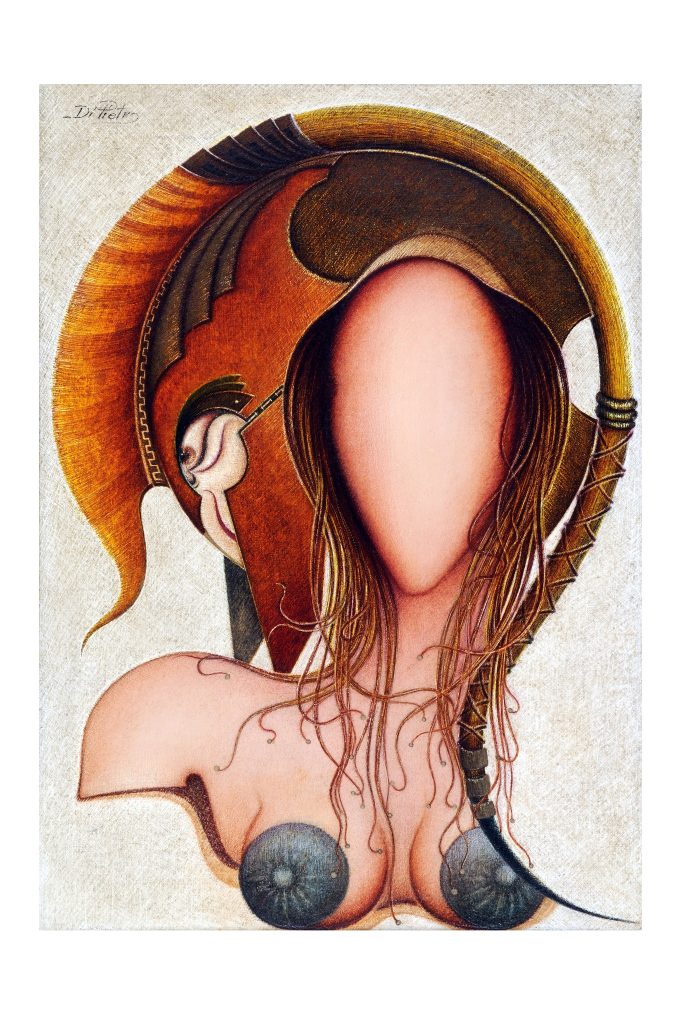
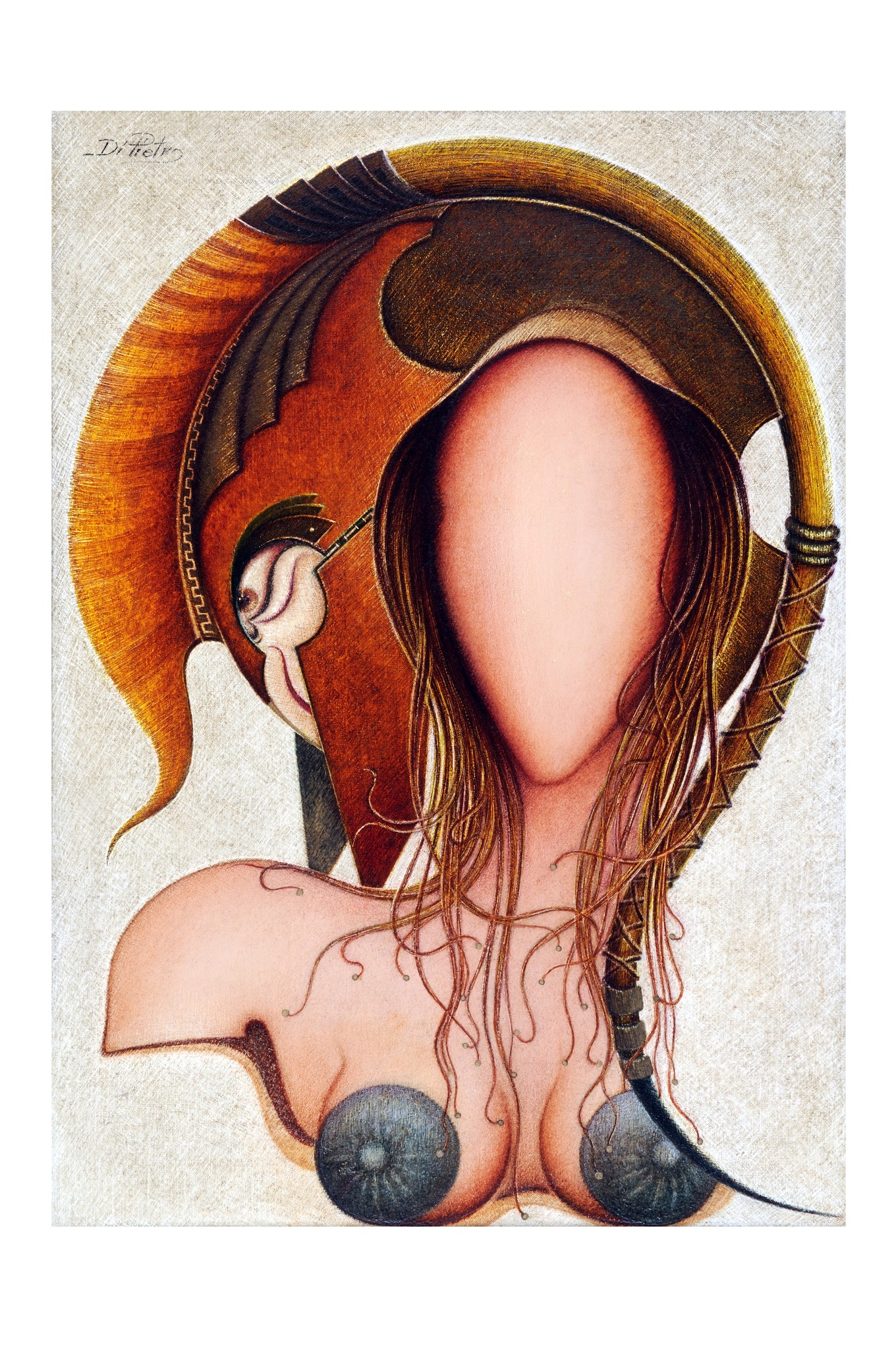
“Elena e Paride” Olio su tela cm. 70x50, serie Iliade - III periodo 1985/1995
“HELEN AND PARIS”
The story of Helen of Sparta and Paris is one of the most famous tales of Greek mythology, at the origin of the Trojan War.
Helen, considered the most beautiful woman in the world, was the wife of Menelaus, king of Sparta. Paris, prince of Troy, was called to choose which of three goddesses—Hera, Athena, and Aphrodite—was the most beautiful. Seduced by Aphrodite’s promise to grant him the love of the most beautiful woman in the world, Paris chose her as the winner.
Guided by this destiny, Paris arrived in Sparta and met Helen. An irresistible love arose between them (or, according to some versions, Helen was abducted), and Paris took her with him to Troy. This act provoked the wrath of Menelaus, who, with the help of his brother Agamemnon and many Greek heroes, organized an expedition to bring her back.
Thus began the long and bloody Trojan War, which saw Greeks and Trojans oppose each other for ten years, transforming a love story into a myth of passion, fate, and destruction.
Here is a significant passage from the Iliad, in which Helen of Sparta and Priam appear, as Helen watches the war from the walls of Troy:
“Better for me had been a cruel death, when I followed your son, leaving home and husband.”
In this passage, Helen expresses her remorse for having followed Paris, acknowledging the pain and destruction caused by their union.
Paris, from Book III, when he is reproached by his brother Hector for his behavior:
“Evil Paris, beautiful, woman-crazy, seducer! would that you had never been born, or had died unmarried! This I would wish, far better than to be thus a shame and disgrace to others.”
In this passage, addressed to Paris, the contrast emerges between his beauty and his lack of warrior valor, a central theme in his character within the poem.
“Helen and Paris” Oil on canvas, 70×50 cm, Iliad series – III period (1985–1995)