
Home
Join Our Newsletter
Enter your email and we'll keep you posted with news and updates!
[fluentform id="4"]
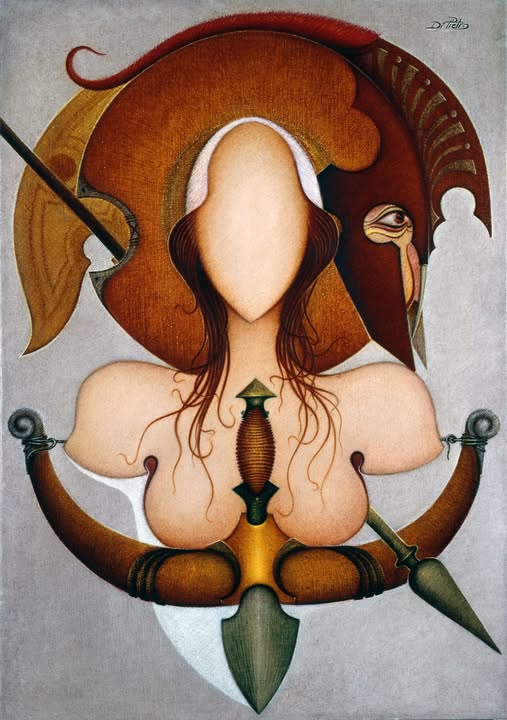
BRUNO DI PIETRO.
Olio su tela, cm 100×70. Serie Iliade, III periodo (1985–1995). L’Iliade come esperienza visiva, tra regia artistica e nuova figurazione.
Il dipinto raffigura Era, tra le principali divinità dell’Olimpo, regina degli dèi e consorte di Zeus. Nella tradizione mitologica è associata al matrimonio e alla fertilità, ma la sua figura si distingue per una complessità segnata da gelosia e spirito vendicativo. Durante la guerra di Troia si schiera a favore dei Greci, animata da un profondo risentimento nei confronti dei Troiani, originato dal giudizio di Paride, figlio di Priamo.
Descrizione dell’autore:
L’opera, eseguita a olio su tela, presenta al centro la figura monumentale di Era, resa come una matrona solenne e dominante. Il corpo assume valore simbolico: le forme generose alludono alla fertilità e alla maternità, evocando la dimensione della nutrizione e della protezione della vita. In questa scelta iconografica la dea incarna il principio generativo e la sacralità del vincolo familiare.
Il volto, austero e impenetrabile, è privo di tratti definiti: un’immagine aniconica che, pur nella sua essenzialità, si carica di una forte risonanza emotiva e di una tensione interiore allusiva al carattere della divinità. L’assenza di espressione, voluta, invita l’osservatore a proiettare un proprio significato, trasformando lo sguardo in un luogo di interpretazione e suggerendo una contemplazione che trascende l’umano, come se la dea scrutasse il destino degli uomini e degli eroi.
Alle sue spalle si dispiega una scena bellica, dinamica e contrastata: scudi ed elmi emergono in un intreccio concitato, entro il quale si possono intravedere, in forma evocativo la presenza di Achille e, sullo sfondo, l’elmo di Ettore, simboli dei due grandi protagonisti del conflitto. Questo sfondo richiama il ruolo di Era quale sostenitrice dei Greci, suggerendo che, pur essendo dea della vita e del matrimonio, essa agisce anche come forza partecipe della guerra, incitando allo scontro e sostenendone l’impeto.
Il contrasto tra la staticità solenne della figura centrale e il movimento tumultuoso dello sfondo genera una tensione visiva intensa: da un lato l’ordine, la maternità e la stabilità; dall’altro la violenza e il caos. Nel suo insieme, l’opera restituisce un’immagine potente e ambivalente di Era, sospesa tra generazione e distruzione, tra amore e vendetta.
“Hera” (Ἥρα, Hēra) Daughter of Rhea and Cronus; in Roman mythology, Juno, consort of Zeus. Oil on canvas, 100 × 70 cm. Iliad series, III period (1985–1995).
The Iliad as a visual experience, between artistic direction and new figuration.
The painting depicts Hera, one of the principal deities of Olympus, queen of the gods and consort of Zeus. In mythological tradition, she is associated with marriage and fertility, yet her figure is marked by a complex nature, shaped by jealousy and a vengeful spirit. During the Trojan War, she openly supports the Greeks, driven by a deep resentment toward the Trojans, originating from the judgment of Paris, son of Priam.
Description of the work according to the artist: The work, executed in oil on canvas, places at its center the monumental figure of Hera, portrayed as a solemn and commanding matron. The body carries symbolic value: its generous forms allude to fertility and motherhood, evoking the nurturing and protective dimension of life. Through this iconographic choice, Hera embodies the generative principle and the sacredness of the familial bond.
Her face appears austere and impenetrable, devoid of defined features: an aniconic image which, in its essentiality, conveys a strong emotional resonance and an inner tension suggestive of the goddess’s character. The deliberate absence of expression invites the viewer to project personal meaning, transforming the gaze into a space of interpretation and suggesting a form of contemplation that transcends the human, as if the goddess were observing the fate of men and heroes.
Behind her unfolds a dynamic and contrasting war scene: shields and helmets emerge in a turbulent interplay, within which one may discern, in an evocative manner, the presence of Achilles and, in the background, Hector’s helmet—symbols of the two great protagonists of the conflict. This martial backdrop recalls Hera’s role as protector of the Greeks, suggesting that, although she is the goddess of life and marriage, she is also an active force in war, inciting and sustaining its violence.
The contrast between the solemn stillness of the central figure and the turbulent movement of the background generates a powerful visual tension: on one side, order, motherhood, and stability; on the other, violence and chaos. As a whole, the work offers a potent and ambivalent vision of Hera, suspended between generation and destruction, between love and vengeance.
